NEXTGEN SCIENCE UK
RESEARCH. DISCOVER. INSPIRE.
Biology
Dr Emily O’Connor, Research Fellow in Evolutionary Ecology and Infection Biology, Department of Biology, Lund University, Sweden.
Why do some animals live for only a few weeks, while others survive for decades or even
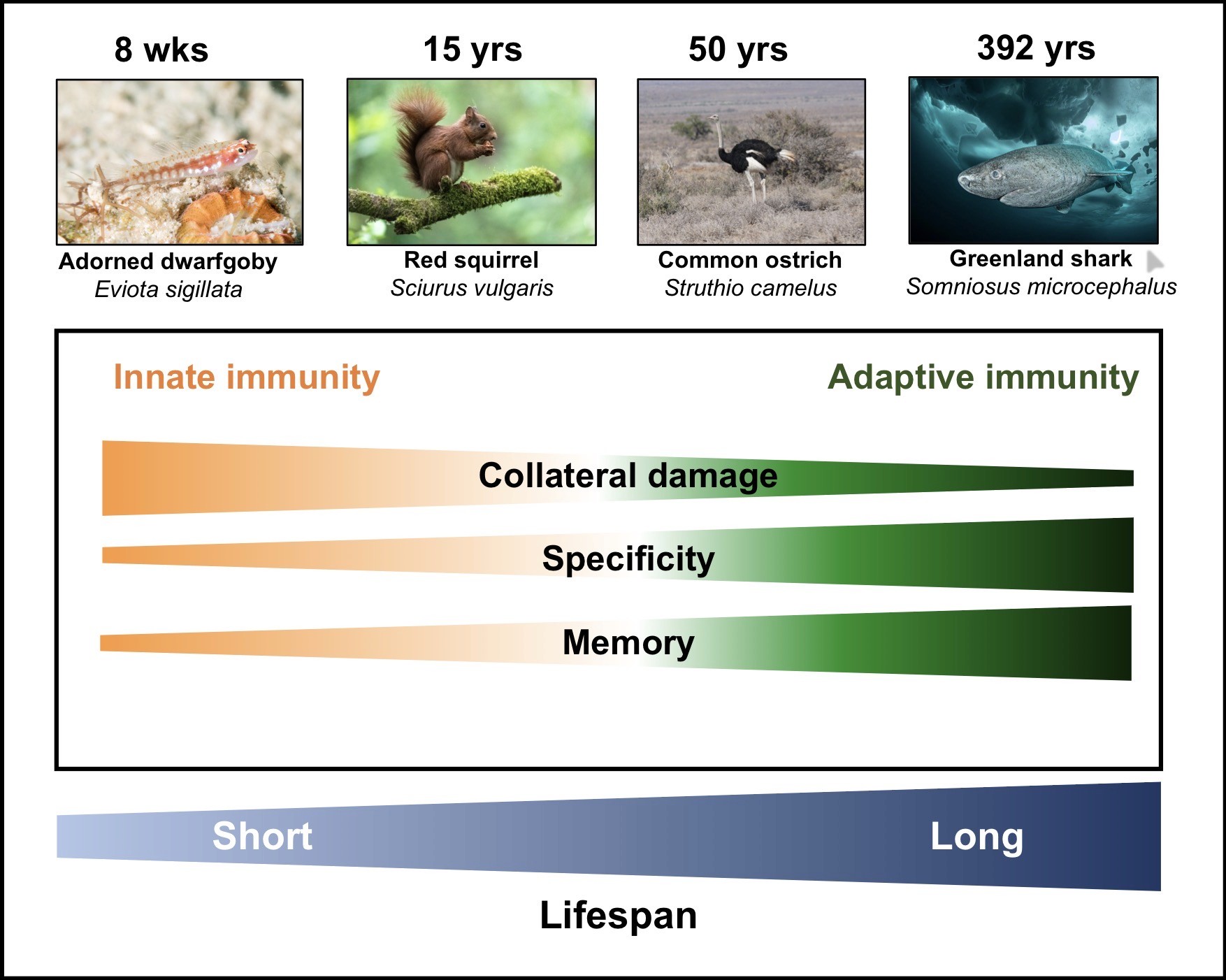
centuries? For example, a species of fish called the Adorned dwarfgoby lives for only about 8
weeks, whereas Greenland sharks can live for more than 300 years. Part of the explanation
may lie in how their immune systems fight infection (Fig. 1).
Fighting pathogens such as viruses, bacteria and parasites is essential for survival, but
immune defence comes at a cost to the host. Vertebrates (animals with backbones) have two
main types of immune defence: innate and adaptive immunity, which work together to fight
invading pathogens. Although these two facets of the immune system interact closely, they
differ in important ways, and species may vary in how heavily their immune responses rely
on innate versus adaptive immunity (McDade et al. 2016).
Innate immune defence acts quickly. It recognises general signs of infection and launches a
broad attack. This makes it an excellent first line of defence, but the response can be fairly
indiscriminate and cause damage to the host’s own tissues. Inflammation is one example. A
short burst of inflammation can help fight infection, but repeated or long-lasting
inflammation can become harmful.
Adaptive immunity, on the other hand, works differently. It takes longer to launch the first
time a pathogen is encountered, but its response is highly targeted. Adaptive immunity can
also ‘remember’ pathogens. If the same pathogen is encountered again in the future,
specialised immune cells can respond faster and more effectively. For a long-lived animal,
which may encounter the same pathogens many times during its life, this memory could be
especially useful. A more targeted response may also reduce the amount of collateral damage
inflicted on the body.
These differences raise an intriguing evolutionary question: has adaptive immunity helped
vertebrates evolve longer lifespans? The answer is not straightforward. Invertebrates do not
have the same form of adaptive immunity as vertebrates, yet some are extremely long-lived.
For example, some species of sea urchin can live for more than 100 years. So adaptive
immunity cannot be the only route to a long life.
So how can we test whether adaptive immunity has played a role in the evolution of long life
in vertebrates? One approach is to compare species with very different lifespans and study
their immune genes, which are stretches of DNA containing instructions for making proteins
involved in recognising and fighting pathogens (O’Connor and Cornwallis 2022). Some of
these genes have particularly important roles in innate immunity, while others are central to
adaptive immunity.
By comparing these genes across short- and long-lived species, we can look for patters associated with the evolution of longer lifespans. For example, do genes involved in adaptive immunity show different patters of evolution from those involved in innate immunity?
Understanding these patterns could reveal an important part of the puzzle of why some species live so much longer than others and how animals balance the need to fight infection with the need to protect their own bodies. This will increase our understanding of this trade-off across all vertebrate species, including humans.
References
McDade, T. W., Georgiev, A. V. and Kuzawa, C. W. "Trade-offs between acquired and innate immune defenses in humans." Evolution, Medicine and Public Health, 2016, 1, p. 1-6.
O'Connor, E. A. and Cornwallis, C. K. "Immunity and lifespan: answering long-standing questions with comparative genomics." Trends in Genetics, 2022, 38(7): 650-661.
Back to Journal
“Science is for everyone.
The future is for young people.”